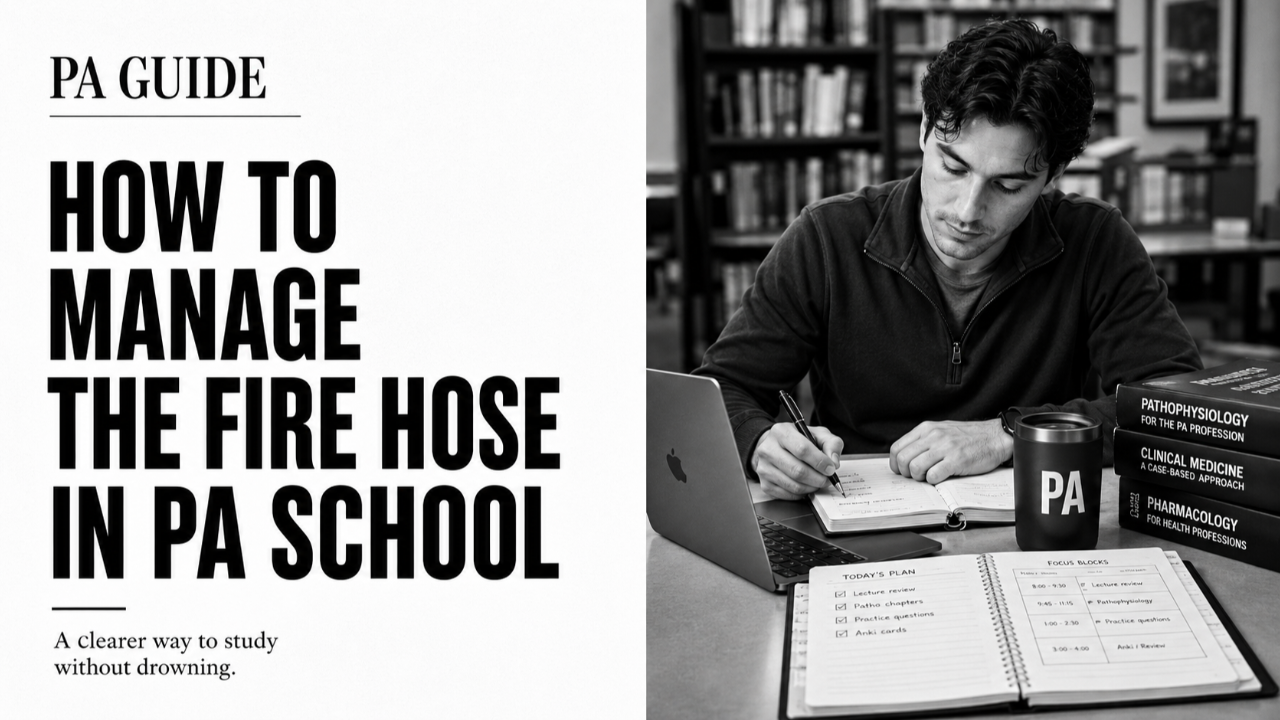
How to Drink from a Firehose
May 08, 2026Every PA school orientation includes some version of the same speech.
A faculty member stands up, smiles sympathetically, and says something like: *“PA school is like drinking from a firehose.”*
Everyone laughs nervously. Nobody asks the obvious follow-up question.
**Okay — so how do you drink from a firehose without drowning?**
That’s the question nobody answers. Instead, you get a syllabus, a reading list, and a “you’ve got this.” Then week one starts and you realize the firehose metaphor was, if anything, an understatement.
This post is the answer to that question. Not vague encouragement. Not a list of generic “study tips.” A real system — one that’s grounded in how memory actually works and built specifically for the volume, pace, and pressure of PA school.
First, Burn the Undergrad Playbook
The study habits that got you into PA school will not get you through it.
In undergrad, you could probably survive on a combination of passive reading, last-minute cramming, and raw test-taking ability. You could skip two weeks of classes, pull a couple of all-nighters before finals, and land a B+. The material had enough surface area that your pattern recognition filled in the gaps.
PA school breaks that strategy in about three weeks.
Here’s why: the curriculum builds. Cardiovascular pathophysiology week one feeds into heart failure week two feeds into pharmacology week three feeds into the clinical management scenario on your exam week four. Miss the foundation and the whole structure is shaky. Try to cram the foundation back in during week three and you’re rebuilding a house from scratch while also learning to frame the second floor.
The students who don’t adapt fast enough to this reality are the ones who fall behind — and in PA school, being behind is a structural problem, not a temporary inconvenience.
So before anything else: decide that what worked before doesn’t apply here. You’re starting over.
The System That Actually Works
This isn’t about working harder. Almost every PA student works hard. This is about building a system that produces durable retention at scale — so that when the exam comes, you’re not trying to remember something you read once. You’re retrieving something you’ve built.
Here’s the framework, broken into five components.
1. Pre-Learn Before Lecture
Most students show up to lecture cold and use the time to hear content for the first time. This is fine in undergrad. In PA school, where a single lecture might cover three diseases, twelve drug mechanisms, and a diagnostic algorithm — it’s a waste of your highest-attention hours.
Instead, spend 20–30 minutes before each lecture doing a quick preview:
- What organ system are we in?
- What conditions are being covered?
- What do I already know about this? (Even if the answer is “nothing much.”)
You’re not trying to learn the content before class. You’re priming your brain so that when the information arrives in lecture, it’s landing on something — not blank space. Primed brains encode faster and retain longer.
This one shift alone changes how much value you extract from a single lecture.
2. Encode Once, Encode Right
When you sit down to study a topic, your goal is not to read through it until it feels familiar. Your goal is to build a mental framework — a structure you can retrieve under pressure.
For each condition or topic, build a framework that answers:
- **What is it?** (Pathophysiology — understand it, don’t memorize it)
- **Who gets it?** (Classic patient profile)
- **What does it look like?** (Presentation — symptoms, signs, classic findings)
- **How do you confirm it?** (Diagnostic workup — what test, what result)
- **What do you do about it?** (Management — first-line, second-line, when to escalate)
- **What will kill you if you miss it?** (Can’t-miss diagnoses, red flags)
That framework is the unit of study. Not a highlighted paragraph. Not a bullet list you copied from the slide. A structured mental model you can reconstruct from scratch.
Build it once. Build it right. Review it repeatedly.
3. Retrieve Before You Review
This is the most important shift you can make and the one most students resist the hardest.
Before you open your notes — every single study session — close everything and write down what you already know about the topic. No peeking. No prompts. Just retrieve.
It will feel uncomfortable. You will get things wrong. You will have gaps.
**Good.** That discomfort is the mechanism. The act of struggling to retrieve a memory — and then checking what you got right and wrong — is what builds durable retention. It’s called retrieval practice, and it is the most consistently evidence-backed study strategy in the cognitive science literature.
Students who re-read without retrieval feel productive but build fragile memories. Students who retrieve first, then review, build knowledge that holds under exam pressure — and more importantly, under clinical pressure when a real patient is in front of them.
After you’ve retrieved what you can, open your notes and check your work. Add what was missing. Correct what was wrong. Then close again and try again.
One cycle of this is worth three read-throughs. That’s not motivation talk — that’s the research.
4. Do Questions Early, but not always
Questions are not just assessment. They’re a study tool — but they are grossly overused.
Most students save question banks as their sole study plan. Start doing clinical-style questions — PANCE-format, scenario-based — from week one of didactics, even on topics you haven’t fully mastered yet but don't rely solely on quizzes
Here’s why: questions expose the gap between what you think you know and what you actually know. And they do it in the exact format the PANCE will use: messy clinical scenario, four options, one best answer. Getting a question wrong on a practice bank costs you nothing. Getting it wrong on boards costs you real money and real time.
More importantly: when you get something wrong, you remember the correction far better than if you’d just read the right answer passively. Error-based learning is unusually durable. The sting of a wrong answer is doing memory work for you.
Build questions into your daily routine. Not a massive block once a week — fifteen to twenty questions a day, reviewed carefully, beats a two-hour question binge every Sunday.
5. Return on a Schedule, Not a Feeling
You will feel like you understand cardiovascular by the end of cardiology week. You will also have forgotten 40% of it by the time renal week ends, and 60% of it by the time you hit rotations.
This is not a personal failure. This is how memory works. The forgetting curve is real, and it doesn’t care how hard you studied the first time.
The fix is spaced return — deliberately going back to material before you’ve fully forgotten it, forcing retrieval, and reinforcing the memory trace.
This doesn’t mean re-reading everything constantly. It means having a review schedule:
- New material: revisit in 3 days
- After 3-day review: revisit in 7 days
- After 7-day review: revisit in 14 days
- After that: into your PANCE prep rotation
A notebook — or any structured reference that maps to the content you need to review — makes this manageable. You’re not re-doing the work of initial learning. You’re spending 10 minutes forcing retrieval on content you already built, patching the gaps, and moving on.
Done consistently, this is what separates students who feel solid on boards from students who feel like they’re seeing the content for the first time.
-----
The Weekly Rhythm
Here’s what this looks like in practice across a week:
**Sunday:** Preview the week’s topics (20 min per topic). Build your frameworks from existing knowledge before you’ve even been to lecture. Note your gaps.
**Monday–Thursday:** Attend lecture primed. After each lecture, spend 30–45 minutes reinforcing the day’s content with retrieval practice before you open your notes. Do 15–20 practice questions on topics from the past week.
**Friday:** Review week. Pull up your notebook or reference materials on topics from 7–14 days ago. Retrieve first, then check. Identify what’s still shaky.
**Saturday:** Light day. 20 questions. Catch up on anything that slipped. Rest is not optional — sleep is where memory consolidation happens. The all-nighter before an exam is actively counterproductive.
-----
What to Do When You Fall Behind
You will fall behind at some point. Almost everyone does.
When it happens, don’t try to “catch up” by going back and re-reading everything you missed. That path leads to panic, all-nighters, and shallow retention across a huge volume of material.
Instead: triage. Which topics are highest-yield? (The PANCE Blueprint tells you — Cardio is 14%, Derm is 6%. Start with what moves the needle.) Build the frameworks for those first. Accept that you’ll have thinner coverage on lower-yield topics for now and fill those gaps after you’ve stabilized your foundation.
A solid understanding of Cardio, Pulm, GI, and MSK will carry you further than surface-level familiarity with everything.
-----
The One Thing That Changes Everything
You can take every tip in this post and still struggle if you do this one thing: treat studying as a passive activity.
Sitting in a library surrounded by books and highlighted notes feels like studying. Watching a lecture recording while eating lunch feels like studying. Re-reading your notes before bed feels like studying.
None of that is studying. It’s exposure. Exposure creates familiarity. Familiarity is not recall. And recall is what gets tested.
The students who consistently outperform in PA school are not the ones who study the most hours. They’re the ones who spend the fewest hours on passive review and the most hours on active retrieval — quizzing themselves, building frameworks, explaining concepts out loud, doing questions under timed pressure.
That shift is the whole game.
-----
Build the System Before You Need It
The students who struggle most in PA school are the ones who wait for the system to emerge. They arrive with undergrad habits, get hit by the first exam, scramble to adjust, fall behind during the adjustment period, and spend the rest of the year in recovery mode.
The students who thrive are the ones who build the system in week one — before the pressure arrives, before the first bad grade, before the firehose opens all the way.
You have the map. You know what the PANCE tests and by what percentage. You know how memory works. You know what study strategies produce durable retention and which ones produce the illusion of it.
That’s enough to build something that actually works.
Start before you need it. Your boards-week self will be grateful.
PA Guide is the tool for the student who wants to stay a head of the onslaught of information! It is the perfect tool for faculty to hand to their students day one!