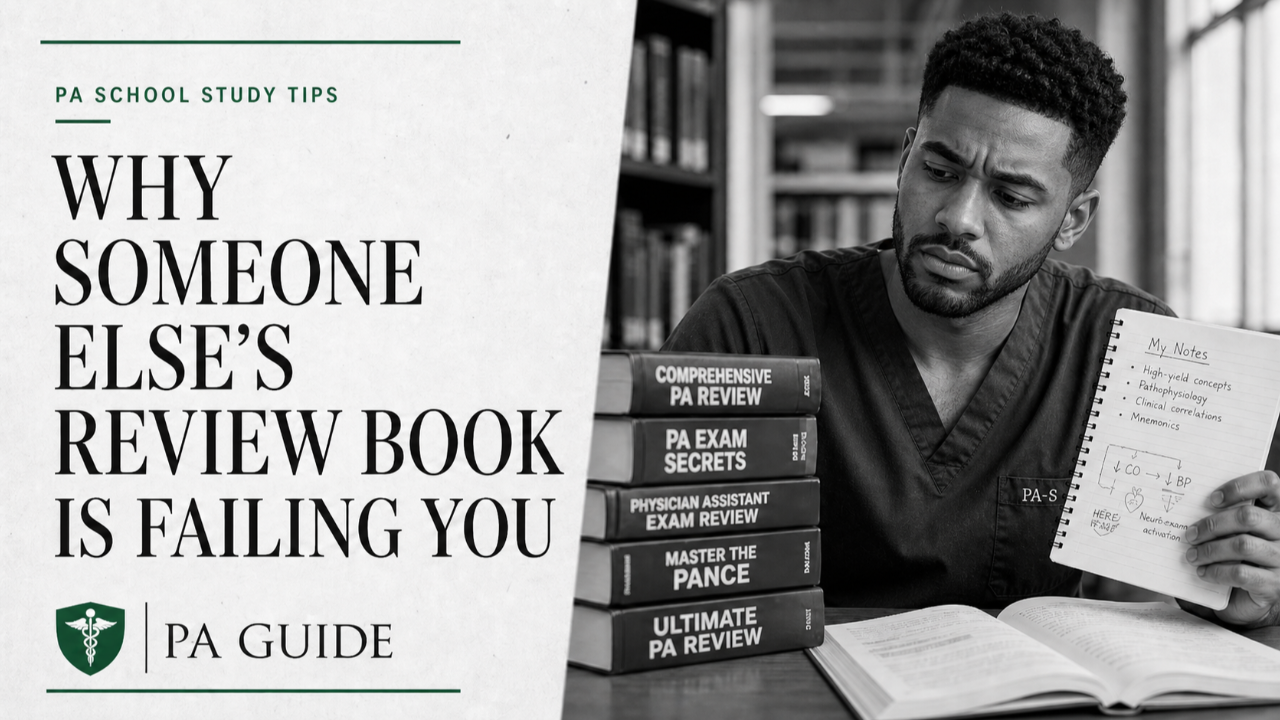
Why Someone Else’s Review Book Is Failing You
May 03, 2026Most review books are not bad.
They are just not enough.
And that matters because PA students keep buying another book, another app, another question bank, another “high-yield” resource, hoping this one will finally make everything click.
But then the same thing happens.
You read the chapter.
You highlight the bold words.
You nod like you understood it.
Then the question stem changes slightly and suddenly your brain leaves the building.
That is not because you are dumb.
It is because most review books give you information.
They do not give you a system.
Here are three reasons someone else’s review book may be failing you.
1. It gives you facts without a framework.
A review book can tell you the symptoms of heart failure.
Great.
But do you understand why they happen?
Do you know how to separate heart failure from COPD, pneumonia, pulmonary embolism, anemia, anxiety, and ACS when the patient just says, “I’m short of breath”?
That is the gap.
Facts are useful.
But facts without structure turn into mental clutter.
PA students do not just need lists.
They need a way to organize the lists.
Chief complaint.
Pattern.
Most likely diagnosis.
Dangerous diagnosis.
Workup.
Treatment.
Next step.
That is how medicine starts to make sense.
2. It teaches you to recognize diseases, not reason through patients.
Most review books are diagnosis-first.
Here is the disease.
Here are the symptoms.
Here is the treatment.
Move on.
But patients are complaint-first.
Chest pain.
Abdominal pain.
Headache.
Dizziness.
Fever.
Weakness.
Shortness of breath.
That is how real medicine shows up.
And that is how board questions are trying to test you.
They are not asking, “Did you memorize a paragraph?”
They are asking, “Can you recognize the pattern and make the next decision?”
That is clinical reasoning.
And if your review book does not help you practice that, it is leaving you with a dangerous kind of confidence.
The kind where you know a lot of words, but you still do not know what to do next.
3. It makes studying passive.
This is the quiet killer.
Reading feels productive.
Highlighting feels productive.
Rewriting notes feels productive.
But passive studying can trick you.
You can spend three hours with a review book and still not be able to explain the topic without staring at the page.
That is not learning.
That is exposure.
PA school requires more than exposure.
You need to retrieve.
Compare.
Explain.
Apply.
Ask why.
Build patterns.
Make decisions.
A good system should force your brain to do something with the information.
Not just stare at it until your eyes glaze over.
The problem is not that you need another review book.
You probably already have enough resources.
Maybe too many.
The problem is that your resources are not working together.
You have lectures over here.
A review book over there.
A Qbank somewhere else.
A pile of flashcards.
Random screenshots.
A half-finished study guide.
And a creeping sense that everyone else has some secret plan you missed during orientation.
They probably do not.
They are probably stressed too.
But the students who start improving usually do one thing differently:
They stop collecting resources and start building a system.
What PA students actually need
You need a way to know what matters.
You need system-based board review.
You need clinical reasoning.
You need complaint-based thinking.
You need active recall that goes beyond “I saw this once.”
You need to understand the why behind the what.
You need a study system that helps you prepare for PA school exams, rotations, EORs, and the PANCE without rebuilding your entire life every Sunday night.
That is why PA Guide exists.
Not because PA students need another giant book to feel guilty about not finishing.
You already have that.
PA Guide was built to help you turn the chaos into something usable.
Bottom line
Someone else’s review book may be failing you because it gives you content without structure.
It teaches recognition without reasoning.
It makes studying feel productive when it may still be passive.
You do not need to memorize harder.
You need a better way to organize medicine.
Learn the pattern.
Understand the why.
Think through the patient.
Then use review books and Qbanks to sharpen the system.
Not replace it.
That is how you stop guessing.
That is how you build confidence.
That is how you start thinking like a PA.
PA Guide is the tool for the student who wants to stay a head of the onslaught of information! It is the perfect tool for faculty to hand to their students day one!