A PANCE practice exam should do more than give you a score.
Practice questions are useful when they show you exactly what to review next. PA Guide helps PA students turn PANCE practice exam results into a real board review plan with system-based review, active recall, flashcards, quizzes, and clinical reasoning practice.
Use practice questions to find the gap — then actually fix it.
Most students do questions, check the score, read a few explanations, and move on. PA Guide helps you connect practice exam performance to the notebook, course, flashcards, and system review that rebuild the weak areas.
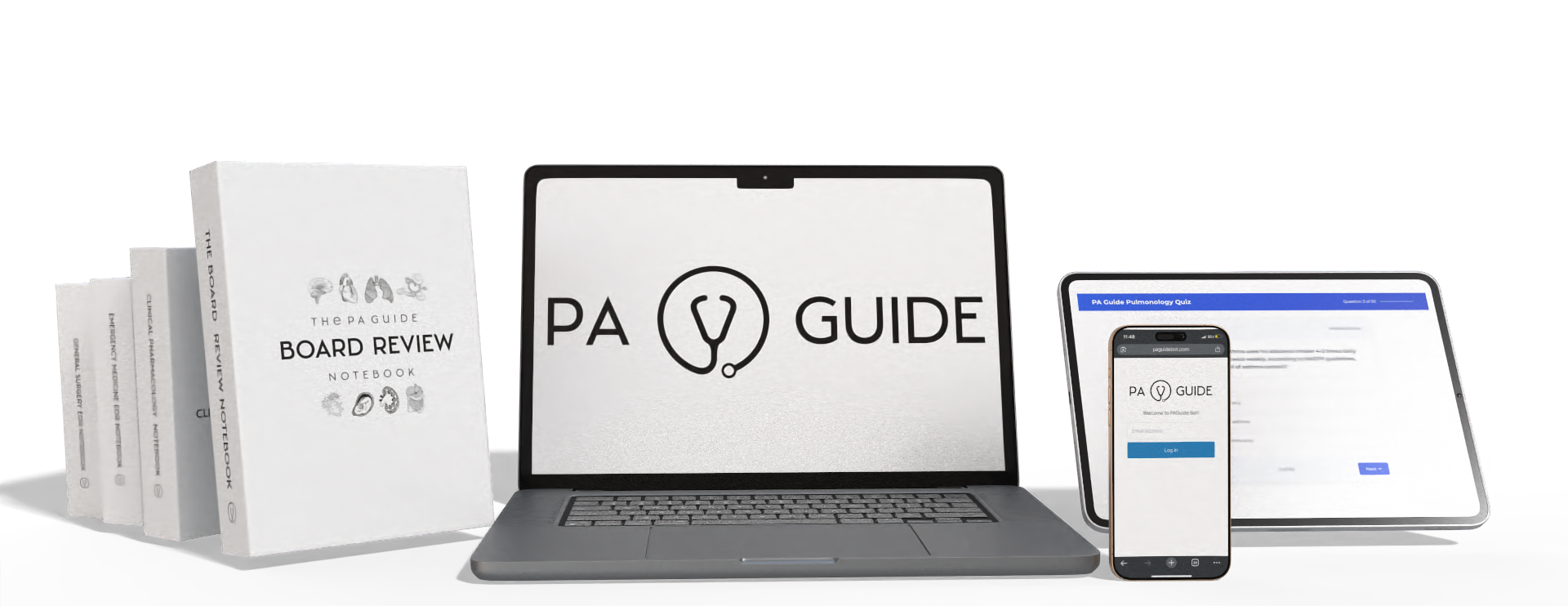
“The score is feedback. The real value is knowing what to study next.”
The Practice Exam Trap
Students obsess over the percentage.
But the percentage is not the plan.
A PANCE practice exam can tell you where you are weak. It cannot automatically organize your cardiology gaps, fix your pulmonary pattern recognition, teach you pharmacology, or make clinical reasoning appear by magic. The score matters. What you do after the score matters more.
Practice exams should diagnose the problem. PA Guide helps you treat it.
Use practice questions to reveal weak areas, then use the notebook, course, quizzes, flashcards, and AI coach to turn those misses into organized review.
What Your Practice Exam Should Show You
Do not just ask, “What was my score?” Ask, “What failed?”
The best practice exam review goes beyond right and wrong. It helps you identify what kind of miss happened, then directs your next round of study.
Knowledge gaps
You missed the fact, pathway, diagnostic criteria, medication, complication, or treatment step.
- Rebuild with notebook review
- Use flashcards for recall
- Retest the concept later
Reasoning gaps
You knew some medicine, but could not choose the next best step, most likely diagnosis, or safest treatment.
- Practice clinical cases
- Ask the AI coach to unpack the logic
- Focus on decision-making
Pattern gaps
You recognized the topic but missed the pattern because the question changed the presentation, lab value, or wording.
- Compare similar diseases
- Review red flags and pivots
- Use mixed recall blocks
The PA Guide Practice Exam Review Method
Take the practice block. Break down the miss. Review the system. Retest smarter.
PA Guide helps you use PANCE practice questions as a diagnostic tool instead of an emotional support percentage.
Take a focused practice block
Start with system-based or mixed PANCE-style questions to expose weak areas without drowning in random review.
Sort the missed questions
Tag misses as knowledge gaps, reasoning gaps, pattern gaps, or test-taking mistakes. Each miss gets a job.
Review the system
Use the PA Guide notebook and course to rebuild the weak concept instead of just rereading a one-off explanation.
Retest with active recall
Use quizzes, flashcards, and cases to prove you can retrieve and apply the concept later.
What Happens After the Practice Exam
The wrong move is just doing more questions.
More questions can help, but only when you understand what the last block revealed. PA Guide gives you the review loop.
The common way
Check the percentage and spiral.
Read the explanations once and hope recognition turns into mastery.
Do another giant random block without fixing the system that failed.
Switch resources because anxiety says the current one is not enough.
The PA Guide way
Use the result to identify weak systems and task areas.
Rebuild the concept inside the notebook and course framework.
Practice retrieval with quizzes and flashcards.
Use clinical cases and AI coaching to apply the concept.
PANCE Practice Exam Review Areas
Use practice questions to find the system that needs attention.
PA Guide helps you review high-yield systems and clinical task areas so your next round of practice is more focused.
Try the tools
Practice questions are the starting line, not the finish line.
Use the free practice tools to see the PA Guide approach, then use the full system to review weak areas, build recall, and sharpen clinical reasoning.
Start with PANCE-style practice questions.
Use missed questions to guide system review.
Move from answer recognition to clinical reasoning.
About PA Guide
Made by someone who knows the difference between testing and learning.
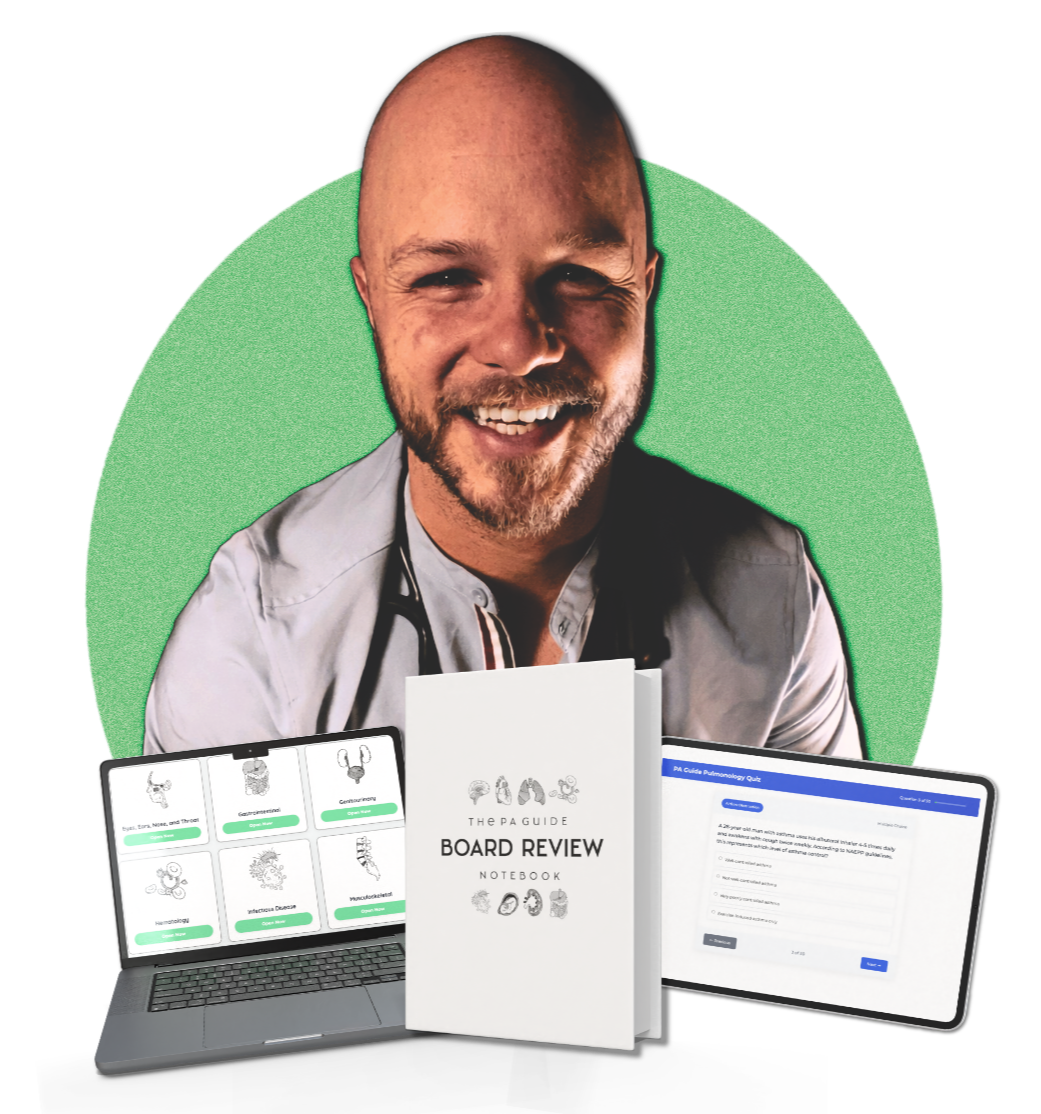
PA Guide was created by Jono Lippman, PA-C, after seeing the same student pattern repeatedly: plenty of effort, plenty of questions, plenty of resources — but no clear framework for turning practice into clinical understanding.
The goal is not to make students worship another resource. The goal is to give PA students a study system that makes practice questions more useful.
Choose Your Access
Turn practice exam results into a real study system.
Students, monthly members, practicing clinicians using CME funds, and PA programs should not all be forced into the same checkout path. Choose the offer that matches your situation.
Lifetime Access
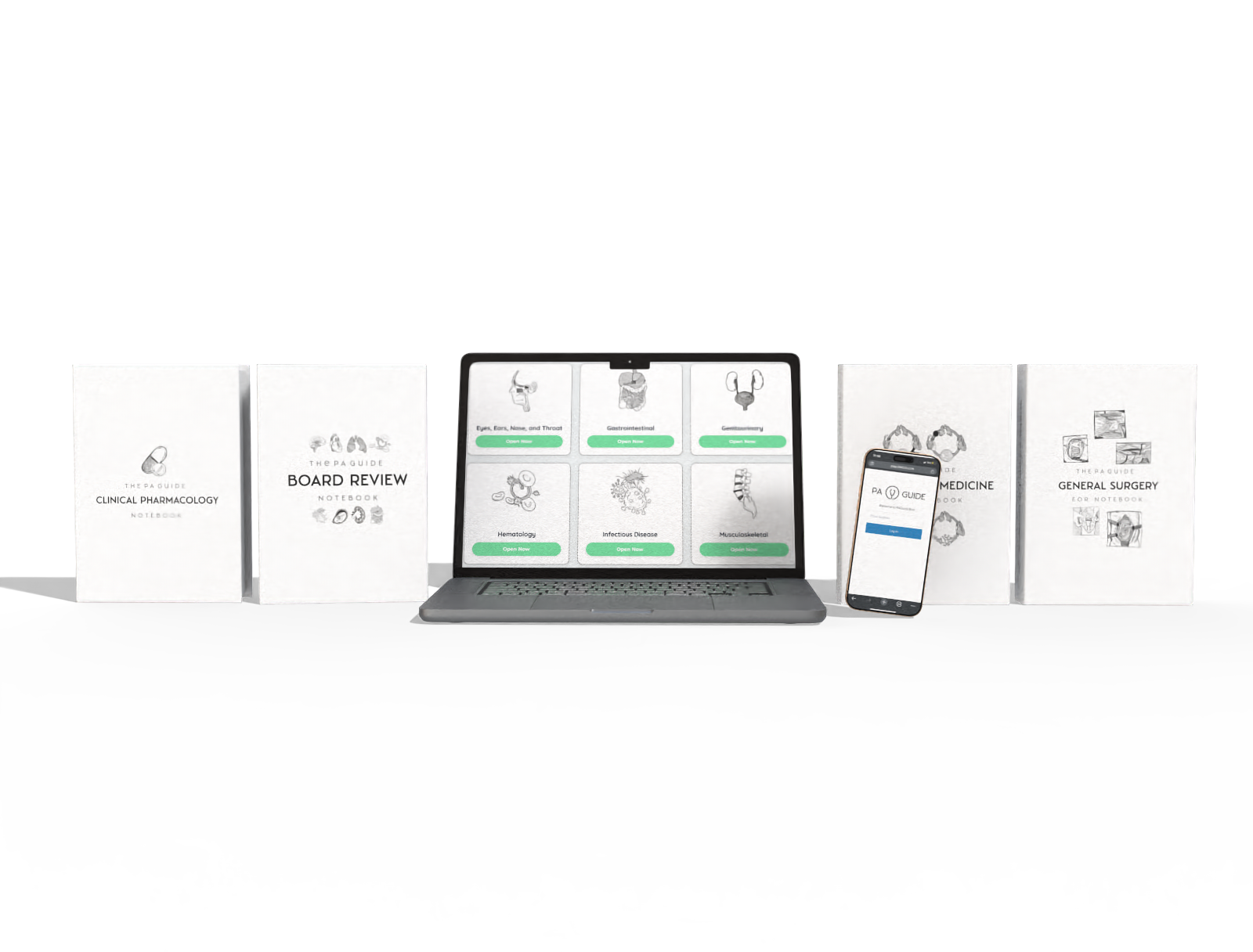
Best for students who want the full PA Guide system without monthly limits.
Use code PAGUIDE15 at checkout.
Notebook + Monthly
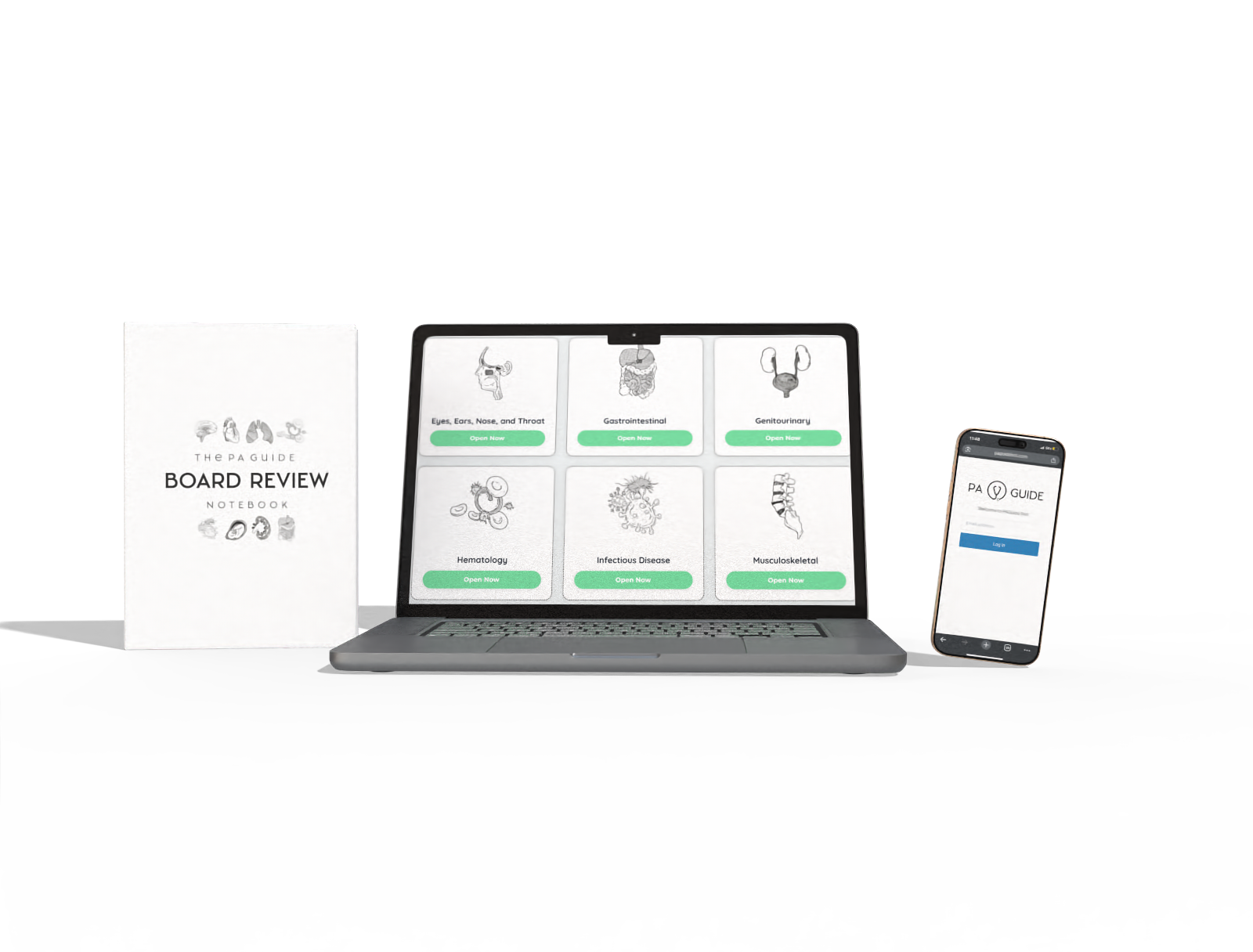
Best for students who want to start with the notebook and keep digital access monthly.
Notebook plus monthly tools access.
CME / Clinical Library
Best for practicing clinicians who want a clinical review system for sharpening, teaching, and onboarding.
CME offer path from prior PA Guide code.
PA Program Access
Best for PA programs that want a shared study system for cohorts, remediation, and clinical reasoning support.
Update this URL if your program checkout uses a different Kajabi offer.
If PA Guide is not the right fit, email within 30 days for a full refund. No drama. No weird hoops.
PANCE Practice Exam FAQ
Questions PA students are already searching.
Clear answers about PANCE practice exams, practice questions, weak-area review, active recall, and how PA Guide helps students turn board prep into a real study plan.
What is a PANCE practice exam?
A PANCE practice exam is a set of practice questions meant to help PA students gauge board readiness, identify weak organ systems, and find gaps in clinical reasoning. The score matters, but the bigger value is seeing what to review next before the actual Physician Assistant National Certifying Exam.
How should I use a PANCE practice exam?
Use a PANCE practice exam as a diagnostic tool, not just a confidence check. After each block, sort missed questions into knowledge gaps, reasoning gaps, pattern-recognition gaps, or test-taking mistakes, then rebuild those weak areas with system review, active recall, flashcards, and repeat practice.
Is PA Guide a PANCE practice exam?
PA Guide includes PANCE-style practice questions, quizzes, flashcards, and clinical reasoning tools, but it is more than a single practice exam. It is a board review system that helps students turn practice exam results into an actual study plan.
How many PANCE practice questions should I do before boards?
There is no perfect number of PANCE practice questions for every student. A better goal is to make sure each practice block changes what you study next. If you keep missing cardiology, pulmonary, pharmacology, emergency medicine, or musculoskeletal questions for the same reason, you need targeted review instead of only doing more questions.
What should I do after a low PANCE practice exam score?
Do not panic and do not immediately switch resources. A low PANCE practice exam score can be useful if it shows you where the study system is breaking down. Start by reviewing the weakest systems, rewriting the concepts into a trusted notebook, using flashcards for retrieval, and retesting the same concepts later.
Can I use PA Guide with another PANCE question bank?
Yes. PA Guide can work alongside another PANCE question bank. The question bank gives you reps and feedback; PA Guide helps you organize the medicine, review weak areas, practice active recall, and build the clinical reasoning framework behind the answer choices.
Should I use system-based practice questions or mixed PANCE practice exams?
Both have a place. System-based practice questions are helpful when you are rebuilding a weak area like cardiology, pulmonology, GI, endocrine, or neurology. Mixed PANCE practice exams are better when you want to test readiness, stamina, and your ability to switch between topics like the real exam.
How does PA Guide help me review missed PANCE questions?
PA Guide helps you move from “I missed this question” to “I know what failed and what to do next.” You can use the notebook and course to rebuild the concept, quizzes and flashcards to practice active recall, and the PA Guide Bot or clinical cases to work through the reasoning.
Is active recall better than rereading PANCE explanations?
Rereading explanations can help briefly, but it often creates false confidence. Active recall forces you to retrieve the concept without seeing the answer, which is closer to what happens on the PANCE. PA Guide uses quizzes, flashcards, and practice tools to help make that recall stronger.
Does PA Guide help with EOR exams and clinical rotations too?
Yes. PA Guide is built for more than final PANCE prep. The same system-based review, flashcards, clinical reasoning practice, and notebook structure can support didactic year exams, End-of-Rotation exams, clinical rotations, and board review.
What is the best way to review weak systems for the PANCE?
Start by naming the weak system, then get specific about the failure point. For example, cardiology weakness might be murmurs, heart failure medications, EKG patterns, chest pain workups, or next-best-step questions. PA Guide helps students review by system so weak areas become concrete and fixable.
Does PA Guide include flashcards, quizzes, and an AI clinical coach?
Yes. PA Guide includes structured notebook review, course content, quizzes, flashcards, clinical reasoning tools, and the PA Guide Bot. The goal is to give PA students more than a pile of questions — it gives them a study system for review, recall, and reasoning.
Is PA Guide better for didactic year, clinical year, or dedicated PANCE prep?
PA Guide can be used in all three stages. Didactic-year students can use it to organize lectures and build a review foundation. Clinical-year students can use it for EOR exams and clinical reasoning. Students near graduation can use it to turn PANCE practice questions into targeted board review.
How do I know if I am ready for the PANCE?
Readiness is not just one practice exam score. Look for consistent performance across mixed question blocks, fewer repeated misses in weak systems, stronger recall without notes, and better next-best-step reasoning. If your score improves but your reasoning still feels shaky, keep reviewing the system behind the questions.
Is PA Guide affiliated with NCCPA?
No. PA Guide is an independent study resource and is not affiliated with or endorsed by NCCPA. Students should use official NCCPA resources for current exam registration, policies, logistics, and blueprint information.
Take the practice questions. Then build the review plan.
PA Guide gives you the notebook, course, quizzes, flashcards, AI coach, and clinical reasoning practice to turn PANCE practice exam feedback into organized board review.
Independent study resource. Not affiliated with NCCPA.