For PA program directors + facultyBuilt by a practicing PA-CDesigned for student support + remediation prevention

Your students are overwhelmed.
Give them a system before they fall behind.

PA Guide gives your program a structured support system that helps students organize content, build clinical reasoning, and stop surviving on qbanks alone.

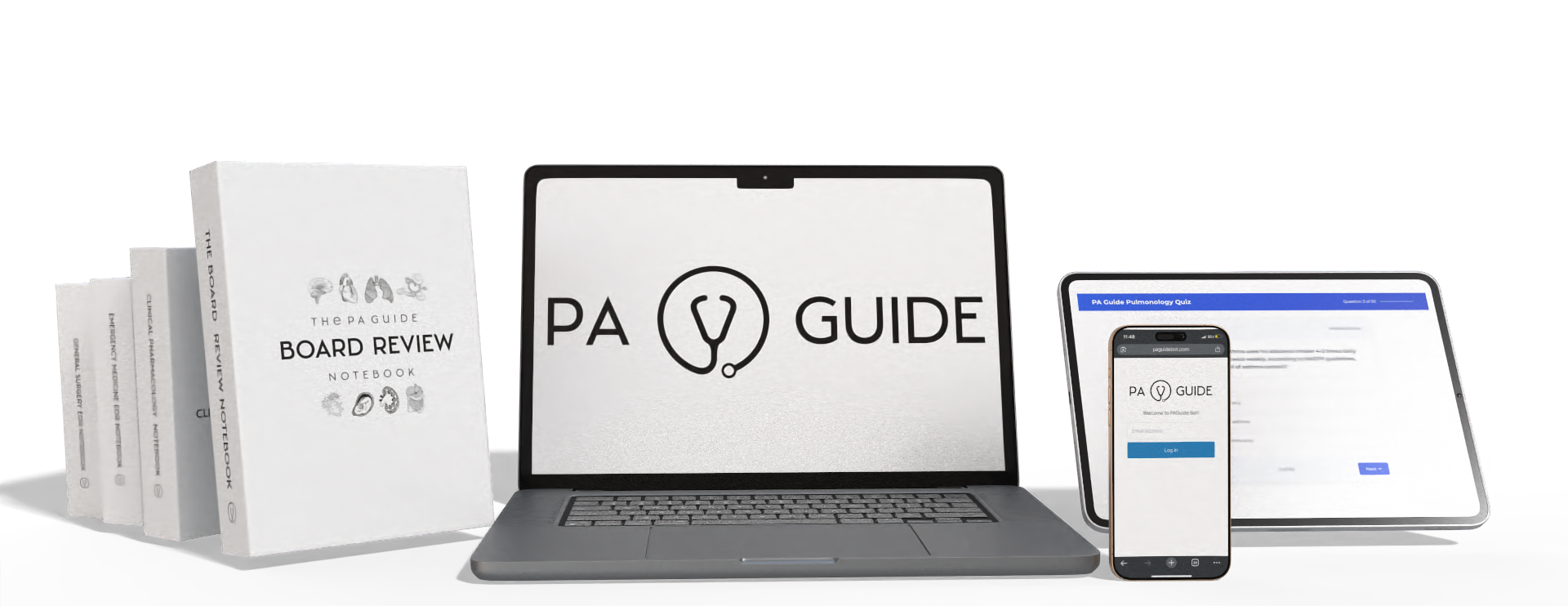
PA Guide notebook and digital tools
Choose a Plan →Talk With PA Guide
30Students included
14Clinical systems
3Program tiers

"More resources do not rescue overwhelmed students. A better system does."

Physical notebook for every student
Full digital platform access
AI clinical reasoning support
Quizzes, flashcards, and cases
Program checkout + onboarding

The Reality

STUDENTS ARE DISTRACTED, OVERLOADED, AND FALLING BEHIND.
FACULTY ARE TIRED OF CARRYING THE REMEDIATION LOAD.

PA school has always been hard. But now students are fighting fragmented attention, endless tech distractions, scattered resources, lecture overload, and the false confidence that comes from doing more qbank questions without learning clinical reasoning.

Are they organizing the material?
Are they thinking clinically?
Are they getting support early enough?

PA Guide gives programs a student support system that reinforces structure, active recall, and clinical reasoning.

Your faculty are already guiding future clinicians. PA Guide gives students a repeatable framework to use before remediation becomes the only option.

DON’T WAIT UNTIL STUDENTS ARE ALREADY IN CRISIS.

Students do not need another random resource. They need a path.

Faculty do not need another remediation burden. They need a shared framework to point students toward.

PA Guide helps your program support the whole cohort with one organized system.

Choose the program tier that fits your cohort.

The Plan

A student support system your program can actually deploy

A simple process: choose a program tier, onboard your students, and give faculty a shared structure for study support, remediation prevention, and clinical reasoning development.

1

Choose your cohort plan

Essential, Partner, and Premier each include up to 30 students, with clear additional-student pricing.

2

We help onboard your students

Students receive the notebook and digital access so they can start using one consistent system.

3

Faculty can point back to the same framework

When students need help, your faculty have a shared structure to reinforce active recall, clinical reasoning, and organized review.

PA Guide system — notebook and digital tools

What Students Get

The notebook gives structure.
The tools give them reps.

PA Guide combines physical organization with digital practice so students can move from scattered notes to clinical reasoning.

📓

Board Review Master Notebook

A physical framework students can build into throughout didactics, rotations, remediation, and boards.

🎓

Course + Clinical Review System

System-based content designed to clarify core medicine, reinforce high-yield concepts, and support long-term review.

🤖

AI Coach + Training Tools

Quizzes, flashcards, clinical cases, and PA Guide Bot for active recall and decision-making practice.

PA Guide — notebook and digital tools
One system. Physical notebook + digital tools — built for didactics, rotations, and boards.

Everything Included

A program support system students can keep using

📓 Physical structure

  • Notebook for every student
  • Organized by clinical systems
  • Built for handwriting, synthesis, and retrieval

⚙️ Digital learning tools

  • Quizzes and flashcards
  • Clinical cases and decision practice
  • PA Guide Bot for clinical reasoning support

🏫 Program-level support

  • Annual cohort renewal
  • Faculty orientation options
  • Premier onboarding and direct support
Choose a Plan →

Why It Matters

Qbanks are useful.
But qbanks are not a learning system.

❌ The Common Pattern

Students jump between lectures, apps, qbanks, and notes
They mistake question volume for understanding
Faculty spend more time reacting once students are behind
Remediation becomes a rescue mission

✅ The PA Guide Way

Students have one organized framework
Active recall is tied to clinical reasoning
Faculty can point students to a repeatable system
Programs support students before they are in crisis
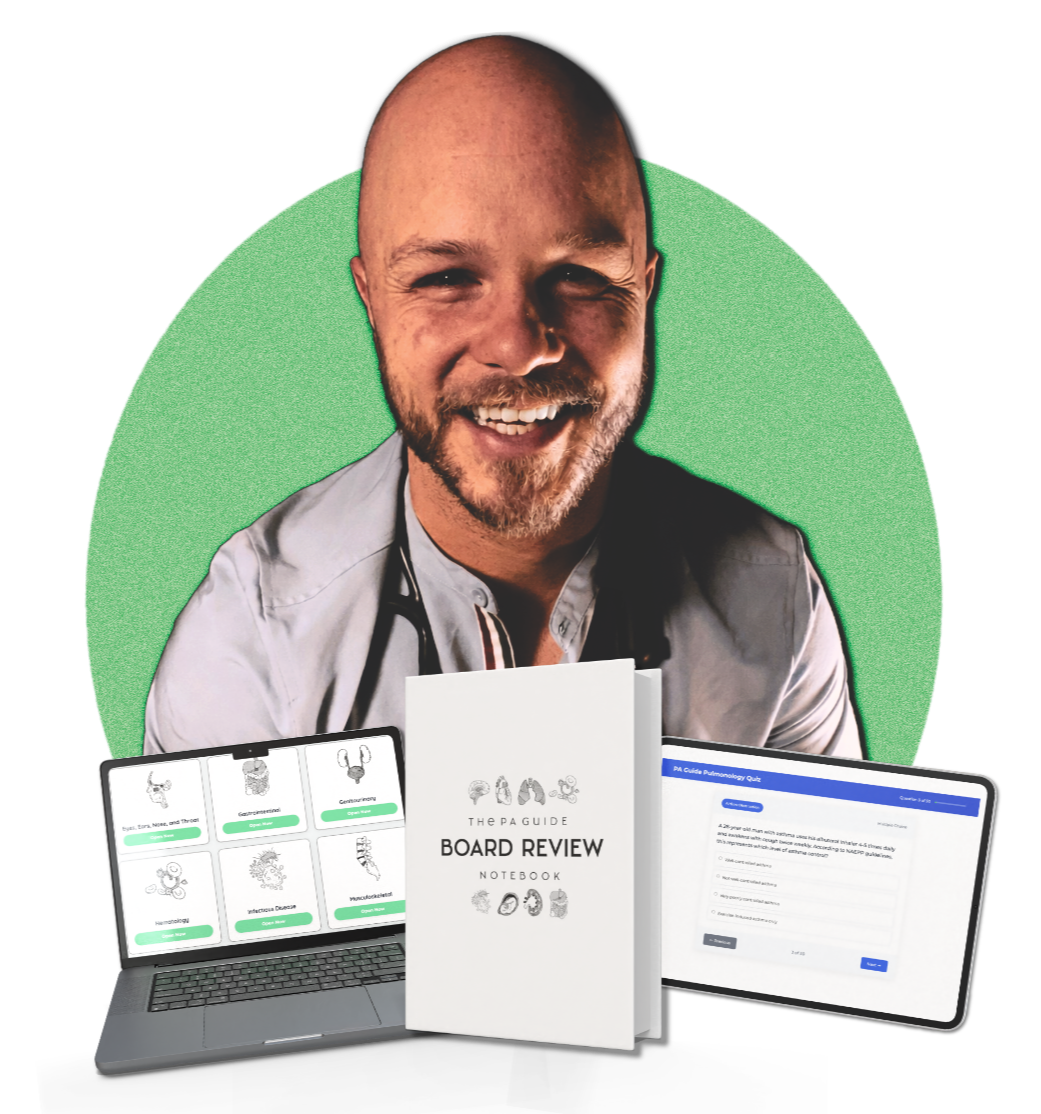
Jono Lippman, PA Guide founder

Built by a PA who lived the pressure

Jono Lippman, PA-C

Husband · Father · Educator · Clinical reasoning mentor

About the Founder

I built PA Guide because I know what it feels like to be overwhelmed in PA school.

I was not a student with unlimited time, perfect focus, and a quiet life. I was a husband and father trying to get through PA school while carrying real responsibility outside the classroom.

What changed everything was not simply working harder. It was building a system: deciding what mattered, organizing it clearly, reviewing it repeatedly, and turning scattered information into clinical thinking.

PA Guide is the system I wish every student had before they fell behind — and the support I wish faculty could hand students before remediation became the only option.

Empathy for overwhelmed students: built by someone who remembers the pressure of learning medicine while life kept moving.

Structure faculty can point to: gives students a repeatable method instead of another disconnected resource.

Clinical reasoning at the center: helps students move beyond memorization and start thinking like future clinicians.

Program Licensing Tiers

Choose the support level that fits your cohort.

All tiers include a physical notebook for every student. Priced per program, not per student. Each plan includes up to 30 students, with additional-student pricing shown below.

Essential
$10,000
per year / up to 30 students
+$199 per additional student
Choose Essential
Most popular
Partner
$13,000
per year / up to 30 students
+$249 per additional student
Choose Partner
Premier
$20,000
per year / up to 30 students
+$299 per additional student
Choose Premier
What every student gets
Board Review Master NotebookIncluded in EssentialIncluded in Premier
Full digital platform accessIncluded in EssentialIncluded in Premier
Clinical Pharmacology NotebookIncluded in Premier
Emergency Medicine Rotation NotebookIncluded in Premier
General Surgery Rotation NotebookIncluded in Premier
All 14 system quizzes + flashcards
PA Guide BotAI clinical reasoning assistant
Clinical case simulator
Faculty & program support
Annual cohort renewal
Live faculty orientation call
Mid-year check-in with Jono
Custom faculty onboarding session
Direct line to Jono
Extras
Co-branded student welcome email
Early access to new modules
Custom notebook cover option
Multi-year pricing available

Example totals for a 60-student program

Essential — 60 students
$15,970/yr
$10,000 base + 30 × $199
Partner — 60 students
$20,470/yr
$13,000 base + 30 × $249
Premier — 60 students
$28,970/yr
$20,000 base + 30 × $299

Trusted by clinicians, educators, and clinical leaders

Clinicians and educators recognize PA Guide as more than another content library — it is a structured way to learn, review, and teach.

Erich Fogg
★★★★★

“Strategic, focused, and grounded in how real students learn — not another content dump.”

Erich Fogg, PA-C, MMSc

High-Stakes Exam Coach | Educator

Troy Bender
★★★★★

“Simplifies complex medical concepts and boosts retention — expertly designed notebook + AI chatbot.”

Troy Bender, DMSc, PA-C, DFAAPA

Educator | Former Founding Dean

Ashley Love
★★★★★

“A clear map through overwhelming medical knowledge — rejecting the fire hose mentality.”

Ashley Love, PA-C

Shadow Me Next Podcast

Kristin Burton
★★★★★

“Not just informative — intentional. Built for busy professionals when time is tight.”

Kristin Burton, PA-C

Founder, Millionaires in Medicine

Katie Bean
★★★★★

“Clear, strategic, and rooted in how students learn under pressure — a system that sticks.”

Katie Bean, PA-C

Escape the Clinic | PrePA Clinic

Tracy Bingaman
★★★★★

“Like having a preceptor, study buddy, and hype squad in your pocket.”

Tracy Bingaman, PA-C, MSPAS

The Persistent Provider

Choose a Plan →

PA Program FAQ

Common questions from PA faculty and program directors.

Use these answers to understand how PA Guide supports cohort-wide student learning, remediation prevention, clinical reasoning, and program implementation.

What is PA Guide for PA programs?

PA Guide is a student support system for PA programs that combines a physical Board Review Master Notebook with digital learning tools, quizzes, flashcards, clinical cases, and PA Guide Bot. It helps PA students organize didactic content, practice active recall, and build clinical reasoning before they fall behind.

How does PA Guide help overwhelmed PA students?

PA students often have plenty of effort but no repeatable system for managing lectures, notes, question banks, and board review. PA Guide gives students one organized framework for high-yield medicine, system-based review, active recall, and clinical reasoning practice across didactic year, clinical rotations, EOR exams, and PANCE prep.

Is PA Guide designed to replace our PA program curriculum?

No. PA Guide is not a replacement for your curriculum, faculty, syllabi, or program standards. It is designed to sit beside your existing PA school curriculum as a structured study and review system that helps students organize, retrieve, and apply what your faculty are already teaching.

Can PA Guide reduce remediation burden for PA faculty?

PA Guide is built to support students earlier, before remediation becomes the only option. It gives faculty a shared framework to point students toward when they are disorganized, over-relying on question banks, struggling with weak recall, or having trouble connecting facts to clinical decision-making.

Why not just tell students to use a PANCE question bank?

Question banks are useful, but they are not a complete learning system. A qbank can show what a student missed, but it does not automatically organize the medicine, build a notebook, create an active recall plan, or teach clinical reasoning. PA Guide helps students use questions more effectively by giving them a structure to attach the explanations to.

What do students receive with a PA Guide program license?

Students receive access to the PA Guide learning system, including the Board Review Master Notebook, digital platform access, system-based quizzes and flashcards, clinical reasoning tools, clinical cases, and PA Guide Bot. Higher program tiers may also include additional notebooks such as Clinical Pharmacology, Emergency Medicine, or General Surgery depending on the plan selected.

What PA Guide program licensing tiers are available?

PA Guide currently offers Essential, Partner, and Premier program tiers. Each tier includes up to 30 students, with additional-student pricing available. The higher tiers add more notebooks, faculty support, orientation, onboarding, check-ins, and program-level customization options.

Which PA Guide plan is best for most PA programs?

The Partner plan is usually the best fit for programs that want more than basic access because it includes the Board Review Master Notebook, digital platform access, Clinical Pharmacology Notebook, faculty orientation, a mid-year check-in, and a co-branded student welcome email. Essential works for simpler cohort access, while Premier is best for programs wanting the highest support and customization.

Can PA Guide support didactic-year students?

Yes. PA Guide is especially useful in didactic year because students are learning large volumes of medicine quickly. The notebook and digital tools help students decide what matters, organize lectures by system, review weak areas, and start building a board review resource before dedicated PANCE prep begins.

Can PA Guide support clinical-year students and EOR exams?

Yes. PA Guide can help clinical-year students review high-yield systems, reinforce weak areas, and prepare for EOR exams while continuing to build toward PANCE prep. The system is designed to connect didactics, rotations, EOR review, and board review instead of treating each stage like a separate restart.

How does PA Guide teach clinical reasoning?

PA Guide supports clinical reasoning through system-based review, active recall, clinical cases, decision-making practice, and PA Guide Bot. The goal is to help students move beyond answer recognition and start practicing the kind of reasoning they need for rotations, exams, and real patient care.

How does onboarding work after a PA program purchases?

After a program purchases a tier, PA Guide follows up to coordinate cohort details, student access, notebook fulfillment, and onboarding steps. Partner and Premier tiers include additional faculty support options so the program can introduce the system clearly to students.

Can PA Guide be used for PA school remediation?

Yes. PA Guide can be used as part of a remediation support plan because it gives students a structured way to rebuild weak systems, practice recall, and review clinical reasoning. It is not a substitute for faculty judgment or formal remediation policies, but it gives students a more useful framework than simply doing more random questions.

Is PA Guide only for students who are struggling?

No. PA Guide helps struggling students find structure, but it also helps strong students stay organized and avoid resource overload. Programs can use it as a cohort-wide support system so every student has the same baseline framework for review, recall, and clinical reasoning.

Is PA Guide affiliated with NCCPA, ARC-PA, PAEA, or any PA program accreditor?

No. PA Guide is an independent educational resource and is not affiliated with or endorsed by NCCPA, ARC-PA, PAEA, or any accrediting body. PA programs should continue to rely on official sources for accreditation standards, exam policies, and current blueprint information.
PA Guide

Give your students a system
before they are in crisis.

PA Guide helps your students keep up, think clinically, and become easier to support — while giving faculty a shared framework to point students toward.

Essential · Partner · Premier · Includes physical notebook + digital platform access for your cohort